“Conformity Gate Theory” never came true. There was no secret episode. No surprise drop on Jan. 7. No grand reveal waiting behind the credits. But if it had happened—if “Stranger Things” had actually pulled it off—it wouldn’t have just shocked the internet. It would have changed television forever.
At its peak, Conformity Gate Theory took over the internet in a way few fan theories ever have. It wasn’t just one idea, but dozens of tiny theories that fit together like puzzle pieces, all pointing toward the same conclusion: the finale we watched wasn’t real. At first, it sounded absurd—borderline delusional. But the reason it spread so fast is because, for a moment, it felt possible. And that possibility is what made it so powerful.
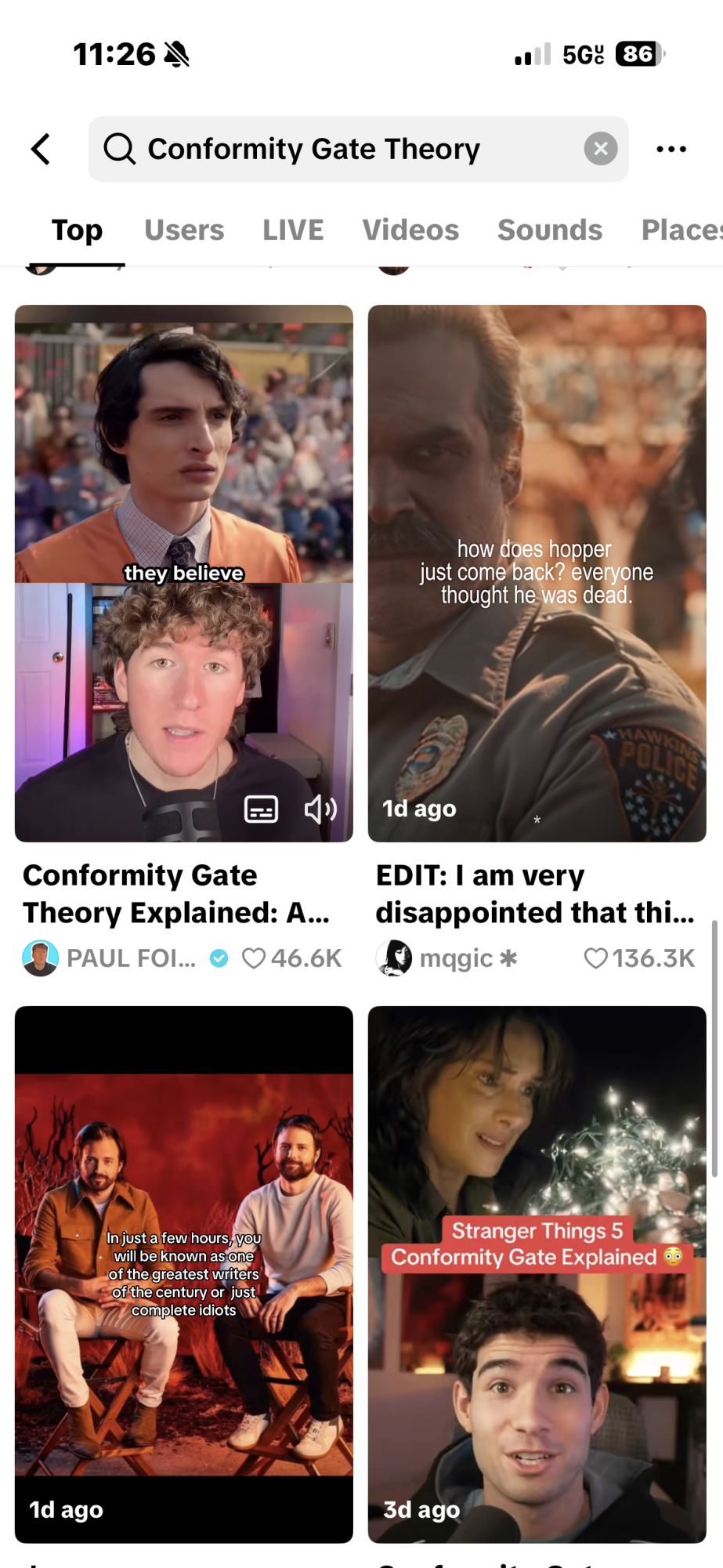
What made Conformity Gate Theory so compelling wasn’t the promise of another episode—it was the idea behind it. The theory challenged something audiences are trained to accept without question: endings. When the screen fades to black and the credits roll, we’re conditioned to believe the story is over. Conformity Gate flipped that assumption entirely. It suggested that the finale wasn’t an ending at all, but a test—a fake conclusion designed to see whether viewers would accept it simply because they were told it was “the end.”
If that had been intentional, it would’ve been genius.
The Duffer Brothers have always trusted their audience to pay attention. “Stranger Things” thrives on hidden clues, callbacks, and details that don’t fully make sense until much later. From Dungeons & Dragons metaphors to background visuals that foreshadow entire seasons, the show trained viewers to look deeper. That’s why the idea of a completely straightforward, unquestionable ending felt strange to some fans. Conformity Gate argued that this discomfort was the point—that the loose threads, fourth-wall cracks, and even moments like Will referencing things he couldn’t realistically know were deliberate signals meant to be noticed.
That’s where the ice cream theory and other mini-theories came in. On their own, they sounded like reaches. Together, they formed a pattern—one that suggested symbolism, repetition, and intentional timing rather than coincidence. If “Stranger Things” had actually revealed another episode that reframed everything, it wouldn’t have just been continuing the story. It would’ve been commenting on storytelling itself.
That’s what would have made it the greatest plot twist in television history.
Most plot twists exist inside the story. This one would’ve existed between the story and the audience. It would’ve revealed that the real experiment wasn’t in Hawkins or the Upside Down—it was us. Did we question the ending? Did we notice what didn’t add up? Or did we accept it and move on because the platform told us it was finished?
No show has ever dared to mess with its audience on that level.
A fake ending would’ve mirrored Stranger Things’ biggest theme: control. Hawkins is constantly being lied to—by the government, by authority figures, by people who claim they’re protecting everyone. If the audience had been deceived too, it would’ve put viewers in the exact same position as the characters: confused, suspicious, and unwilling to accept the truth at face value.
In reality, Conformity Gate didn’t happen. But the fact that it felt plausible says everything about the legacy of the show. “Stranger Things” created a world where viewers don’t trust the surface, where they’re trained to question what they’re shown. And maybe that’s the most meaningful ending of all.
Because even without a secret episode, the theory itself proved something remarkable: Stranger Things didn’t just tell a story—it taught its audience how to think. And honestly? That kind of impact is the most “Stranger Things” ending possible.