Editor’s Note: This review contains spoilers for the movie, “Project Hail Mary.”
Originally released on March 20, “Project Hail Mary” quickly became one of the most talked about films this year. Following its strong box office performance, Amazon MGM Studios extended its theatrical run delaying its streaming release.
Based on the novel by Andy Weir, the film follows Ryland Grace, a middle school science teacher who wakes up alone on a spacecraft with no memory of who he is or how he got there. As he begins to piece together his identity, he discovers he is humanity’s last hope to stop a global extinction threat. Along the way, he encounters an unexpected ally, Rocky, who is an alien from another species facing the exact same crisis.
Directed by Phil Lord and Christopher Miller, the film debuted with a 95% critic score and a 98% audience score on Rotten Tomatoes. Another reason for the film’s success may be its timing. With increased public interest in space exploration, especially surrounding the Artemis II mission, audiences are more drawn to stories that explore science and humanity’s future beyond earth. “Project Hail Mary” fits directly into that growing interest. After seeing the movie twice, once in IMAX, once in a standard theater and reading the book, I believe the film lives up to that reception.
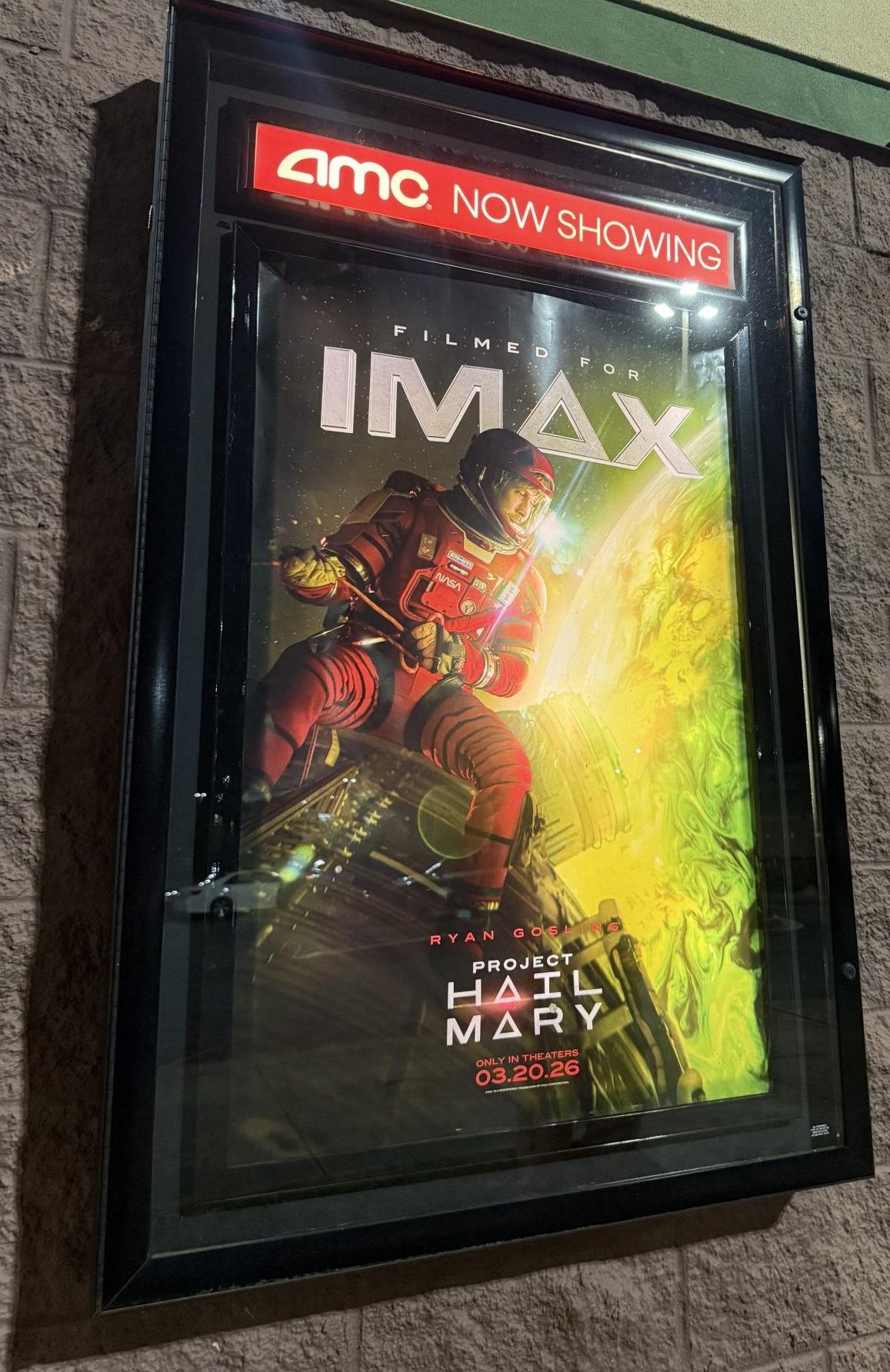
Visually, the movie stands out immediately. By avoiding green and blue screens entirely, the film feels more grounded and immersed with outstanding visuals. The film was also specifically filmed for IMAX, short for Image Maximum, which is a premium movie format that brings expanded aspect ratios, improved sound and bigger screens. Watching in IMAX especially made it feel like I was actually on the Hail Mary ship rather than watching actors and a puppet on a set.
A major strength of the film is its performances, particularly Ryan Gosling as Ryland Grace. His portrayals feel genuine, especially in his intersections with Rocky. Their relationship is easily the highlight of the movie, balancing humor and emotion in a way that makes their bond feel real. Moments like the iconic “fist my bump” line and Rocky’s expressive communication stood out, especially with how the film adapted his language into something more understandable for audiences.
Some of the most impactful scenes come from quieter character moments. When Grace teaches Rocky how to hug, the scene becomes unexpectedly emotional. Another standout moment occurs when Grace tells Rocky he will watch him sleep, but that Rocky has to wake up. This mirrors an earlier moment in the film where Rocky insists on watching Grace, creating a full circle connection that strengthens their relationship and adds emotional weight to the ending.
The film also keeps smaller details from the book that fans will recognize. One example is the reference to The Beatles. With the novel, Weir dedicates the book to the four Beatles members. When Grace sends small specialized ships known as probes back to Earth containing important data, they are named after the four members of the band, Paul, John, George and Ringo. This moment occurs as the audience begins to figure out that Grace has chosen to stay with Rocky on Erid, Rocky’s home planet, rather than return home to Earth. While I appreciated the inclusion, the movie does not explain the reference as clearly as the book which may lessen its impact for the viewers unfamiliar with the source.
Despite its strengths, the film does have some weaknesses. One of my main critiques is the opening. In the book, Grace’s memory loss plays a much more significant role in building the suspense, as he slowly uncovers who he is. In the movie, he quickly remembers his name and that he was a teacher, which removes some of the mystery and tension that made the beginning of the book more engaging.
However, the film also introduced new elements that work well. One addition that stood out to me was Grace’s lighthearted friendship with his bodyguard, Carl. A major part of the movie was exploring Grace and Carl’s new found friendship, while Grace is trying to solve a scientific mystery. These interactions provide funny moments that help balance the heavier themes of the story.
Overall, “Project Hail Mary” is one of the strongest book to film adaptation in recent years. It remains faithful to its source while making effective changes for the screen. The combination of strong performance, emotional storytelling and immersive visuals makes it a film worth watching, especially in theaters. The ending in particular stood out to me. Seeing Grace teaching the young Eridian students on Erid almost word for word from Weir’s novel perfectly captures the heart of the story and reinforces why this adaptation works so well.